The refund window attaches to this desk
Buying here puts your order with the desk that answers +1 (727) 351-3065 and applies the 60-day window. An order placed somewhere else is somebody else's policy and we cannot help with it.
Joint Glide is a dietary supplement capsule for everyday joint support.
Use case: Adults who want a steady morning habit take two vegetable capsules with 8 oz of water and a few bites of food; one 60-capsule bottle lasts 30 days.
How it works: Ten ingredients each print an amount, including devil's claw 500 mg, MSM 300 mg, glucosamine 200 mg, pine bark 150 mg and white willow bark 150 mg.


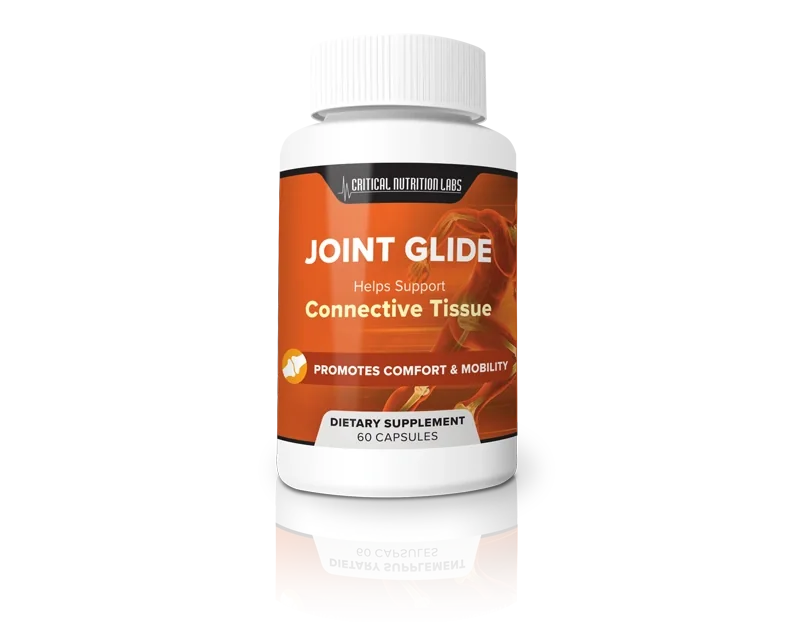


Joint Glide is a vegetable capsule supplement by Critical Nutrition Labs: two capsules each morning, 60 to a bottle, 30 days a bottle. All ten ingredients print an amount, there is no proprietary blend, and a 60-day guarantee runs from purchase. The price shows at checkout.
Every line below is read off the printed label or the brief we were given. On this product most of the rows have something in them, which is not true of everything on this desk.
| Detail | What the label and the seller say |
|---|---|
| Product | Joint Glide, by Critical Nutrition Labs, a joint and connective tissue supplement |
| Front of bottle | Critical Nutrition Labs · JOINT GLIDE · Helps Support Connective Tissue · Promotes Comfort & Mobility · 60 Capsules |
| Supplement Facts panel | Complete. Serving size, servings per container, every amount and a correct footnote |
| Serving | Two capsules each morning with 8 oz of water and a few bites of food |
| Servings per bottle | 30. A bottle is exactly thirty days |
| Amounts printed | Ten of ten dietary ingredients |
| Proprietary blends | None. There is no blend anywhere on this label |
| Percentages | All four correct against the FDA’s published Daily Values |
| Standardisation | Two of six. Pine bark to 95% PACs, black pepper to 95% piperine |
| Largest ingredient | Organic devil’s claw powder, 500 mg |
| Capsule shell | Cellulose. Other ingredients: cellulose and olive oil, two items |
| Allergen statement | Soy Free on the label. Nothing about shellfish |
| Caution panel | None printed on the label images we were given |
| Manufacturer | Critical Nutrition Labs, named on the front. No address printed |
| Price | Not published to us. The checkout is the only figure |
| Guarantee | 60 days from purchase. Two supplied graphics agree on it |
| Shipping | Ships from the United States. Cost and speed: not published |
| Order desk | +1 (727) 351-3065, with your order ID |
| Sold by | Thejointglide, U.S. stocking partner for Joint Glide |
Joint Glide has the most complete label this desk has read: ten of ten ingredients print an amount and no proprietary blend is used. The glucosamine is about an eighth of a trial dose and the MSM about a fifth, and white willow bark brings blood thinner cautions.
Joint Glide is the first product this desk has written up whose label prints an amount for every single dietary ingredient. Ten of ten, no proprietary blend, four percent Daily Values that all survive the arithmetic, two extracts that state what they are standardised to, amino acid chelates rather than oxides, and an other-ingredients line two items long. That is a genuinely good label. It also means the numbers can be checked, and two of them come up short: the glucosamine is about an eighth of a trial dose and the MSM about a fifth. And the white willow bark brings real cautions about blood thinners, NSAIDs and aspirin sensitivity that the label carries no caution panel to mention.
Ordering here puts your order on the desk that answers +1 (727) 351-3065 and applies the 60-day window to it. Price is whatever the checkout prints; we publish no figure we have not seen.
The unusual thing about the Joint Glide label is that every dietary ingredient prints a milligram amount and no proprietary blend is used. All four printed percent Daily Values are correct, and two extracts state their standardisation. That makes the numbers checkable.
Every other product this desk has reviewed opens with a criticism. This one opens with a fact that took us by surprise.
There is no proprietary blend on this label. Ten dietary ingredients are declared and every one of them carries a milligram figure: vitamin B6 0.5 mg, magnesium 100 mg, zinc 10 mg, copper 2 mg, devil’s claw 500 mg, MSM 300 mg, glucosamine hydrochloride 200 mg, pine bark extract 150 mg, white willow bark extract 150 mg and black pepper extract 10 mg.
We recalculated all four percent Daily Values against the FDA’s published figures. B6 is 29.4%, printed as 29. Magnesium is 23.8%, printed as 24. Zinc is 90.9%, printed as 91. Copper is 222.2%, printed as 222. Four for four, every one correctly rounded.
Two of the six botanical extracts state what they are standardised to, on the panel: pine bark to 95% proanthocyanidins and black pepper to 95% piperine. A standardisation is what turns a weight of powder into a dose you can compare with research, and most labels in this category carry none at all.
The forms chosen are the better ones. The B6 is pyridoxal 5’-phosphate rather than plain pyridoxine. The magnesium, zinc and copper are amino acid chelates rather than oxides — and the NIH lists magnesium oxide among the least well absorbed forms. Copper is included alongside zinc for exactly the reason a formulator should include it: the NIH notes that excessive zinc supplementation can lead to copper deficiency.
And the other-ingredients line is two items long: cellulose (vegetable capsule) and olive oil. No stearates, no silicon dioxide, no filler.
None of that tells you the product works. What it tells you is that somebody wrote this label properly, and that the rest of this site can do arithmetic rather than guess.
Because the criticisms further down this page — the glucosamine dose, the MSM dose, the missing salicin figure — exist only because the label printed the numbers that make them visible. A product that hid all of it inside a blend would have escaped every one of them, and would have been a worse product.
The Joint Glide label lists a serving size of two capsules and thirty servings per container, four nutrients with percentages, and six more ingredients with milligram amounts. There is no proprietary blend, and the lot reference is JOI-26/TH-3366.

Joint Glide is a dietary supplement in cellulose capsules, 60 to a bottle, taken two each morning with 8 oz of water and a few bites of food. The formula is four vitamins and minerals plus six joint-directed ingredients, and the front names Critical Nutrition Labs.

A dietary supplement in cellulose capsules, sixty to a bottle. The instruction is specific: simply take 2 capsules each morning with 8 oz of water and a few bites of food. That names the count, the time of day, the volume of water and the food, which is more direction than most labels in this category give.
Two capsules is one serving and there are thirty servings in a bottle, so a bottle is exactly thirty days. Every amount on the panel is what two capsules deliver.
The formula is four minerals and vitamins plus six joint-directed ingredients. The four are vitamin B6, magnesium, zinc and copper. The six are devil’s claw, MSM, glucosamine hydrochloride, pine bark extract, white willow bark extract and black pepper extract.
The front of the bottle carries the manufacturer’s name, Critical Nutrition Labs, and two modest claims: helps support connective tissue, and promotes comfort and mobility. No disease is named anywhere on the pack.
Order Joint Glide through this desk because the 60-day refund window and the order phone line apply only to orders placed here. The dosing arithmetic and the willow bark cautions are printed on the same page as the buy button.
Three practical reasons, none of them a claim about the product.
Buying here puts your order with the desk that answers +1 (727) 351-3065 and applies the 60-day window. An order placed somewhere else is somebody else's policy and we cannot help with it.
Every amount on the label set beside the dose the research used, including the two comparisons the brand would rather you did not make. That is on the dosage section of this page and it is not hidden behind a link.
White willow bark contains salicin. Blood thinners, NSAIDs, aspirin sensitivity and Reye syndrome in children are all live concerns, and the label prints no caution panel of its own. We print them here.
The Joint Glide panel gets five things right: a clear serving size, an amount for every ingredient, four correct percentages, two stated standardisations and a two-item other-ingredients line. It lacks a caution panel, a storage line, an age limit and a distributor address.
Tab through them. Each is a line 21 CFR 101.36 asks for, and on this product five of the six are answered properly.
Simply take 2 capsules each morning with 8 oz of water and a few bites of food.
Two capsules is one serving, and there are 30 servings in a 60-capsule bottle. So a bottle is exactly thirty days, and every amount on the panel is the amount two capsules deliver.
Four nutrients with a percent Daily Value, and six further ingredients each with a milligram figure and a double asterisk for Daily Value not established.
There is no proprietary blend on this label. That is the single most unusual thing about this product, and it is the reason this site can do arithmetic that the other sites on this desk cannot.
We recalculated all four: B6 0.5 mg against a 1.7 mg DV is 29.4%, printed as 29. Magnesium 100 mg against 420 mg is 23.8%, printed as 24. Zinc 10 mg against 11 mg is 90.9%, printed as 91. Copper 2 mg against 0.9 mg is 222.2%, printed as 222.
Four for four, every one correctly rounded.
Pine bark extract is standardised to 95% proanthocyanidins and black pepper extract to 95% piperine. Both are printed on the panel.
The two that are not are the two that most need it: devil's claw is a powder with no harpagoside figure, and white willow bark has no salicin figure — and salicin is the compound behind every caution on our safety page.
Other Ingredients: Cellulose (vegetable capsule), Olive Oil.
Two items, and that is unusually short. A plant capsule shell and one carrier oil, with no magnesium stearate, no silicon dioxide and no microcrystalline cellulose filler. The shell being cellulose is why the vegetarian mark on the listing is supportable.
No storage instruction, no caution panel, no age restriction and no distributor address appear on the label images we were given.
They are the only real gaps on an otherwise exemplary panel, and on a product containing willow bark the absent caution panel is the one we would most like to see filled.
The Joint Glide Supplement Facts panel lists vitamin B6 0.5 mg, magnesium 100 mg, zinc 10 mg and copper 2 mg with percentages, then devil's claw 500 mg, MSM 300 mg, glucosamine 200 mg, pine bark 150 mg, white willow bark 150 mg and black pepper 10 mg.
Four nutrients with percentages, then six more with a figure and a double asterisk. Nothing is hidden behind a total.
| As printed on the panel | Amount per 2-capsule serving | % Daily Value |
|---|---|---|
| Vitamin B6 (as pyridoxal 5’-phosphate) | 0.5 mg | 29% |
| Magnesium (as magnesium amino acid chelate) | 100 mg | 24% |
| Zinc (as zinc amino acid chelate) | 10 mg | 91% |
| Copper (as copper amino acid chelate) | 2 mg | 222% |
| Organic Devil’s Claw Powder (Harpagophytum procumbens) (root) | 500 mg | Daily Value not established |
| MSM (methylsulfonylmethane) | 300 mg | Daily Value not established |
| Glucosamine Hydrochloride | 200 mg | Daily Value not established |
| Pine Bark Extract (Pinus massoniana) | 150 mg | Daily Value not established |
| White Willow Bark Extract | 150 mg | Daily Value not established |
| Black Pepper Extract (fruit) | 10 mg | Daily Value not established |
There is no proprietary blend. Ten dietary ingredients are declared and every one of them carries a figure. That is the only time this desk has been able to write that sentence about a product, and it is why the rest of this site can do arithmetic instead of guessing.
The footnote** Daily Value (DV) not established.
Other ingredientsCellulose (vegetable capsule), Olive Oil.
Marks printed on the label itselfNon-GMO · Soy Free · Lab Tested. The Soy Free mark is a real allergen statement. There is no shellfish statement, and glucosamine is commonly manufactured from shellfish.
The six Joint Glide ingredients worth knowing are devil's claw, white willow bark, glucosamine hydrochloride, pine bark extract, copper and MSM. White willow bark needs the most care, and glucosamine and MSM are printed below the amounts used in trials.
Every claim below is sourced to the reference list at the foot of this page, and every one of those sources was opened and read.
The heaviest ingredient in the capsule, printed with its species and plant part. It is a root powder rather than an extract and no harpagoside percentage is given, so it cannot be matched to the trial literature by marker content. It is also the one ingredient the brand's own marketing panel leaves out.
The ingredient this site flags hardest. Aspirin derives from salicin, and Sloan Kettering warns against willow bark with warfarin or other blood thinners, with NSAIDs, in aspirin sensitivity, and in children because of Reye syndrome. No salicin percentage is stated.
Glucosamine trials generally use 1,500 mg a day. This is 200 mg. NCCIH also notes that studies of prescription glucosamine sulfate showed more favourable results than those using other formulations, and this is the hydrochloride.
The best-specified line on the panel: species named, amount printed and the standardisation stated. Pine bark extracts are commonly studied around 100 to 200 mg a day, so this one can actually be compared with something.
A large percentage of a small Daily Value, and well under the 10 mg upper limit. It is paired with 10 mg of zinc, and the NIH notes that excessive zinc can lead to copper deficiency — so including copper alongside zinc is the correct call.
Methylsulfonylmethane, printed with its full chemical name. Knee osteoarthritis trials have generally used 1.5 to 6 grams a day, so 300 mg is well below the studied range. The label prints the number and lets you draw the conclusion.
See the full Supplement Facts panel for every line on the label.
Set against research, Joint Glide's glucosamine is 200 mg against 1,500 mg in most trials, and its MSM is 300 mg against 1.5 to 6 grams. Pine bark at 150 mg sits inside the commonly studied range of 100 to 200 mg.
Two bars per row. This is the first chart on this desk that can draw both, because this is the first label that printed every number.
What this label printsWhat the research usedper two-capsule serving, log scale
Every dietary ingredient on this label carries a printed amount and there is no proprietary blend. That is what makes a comparison possible, and the comparison is not flattering: glucosamine at about an eighth of a trial dose and MSM at roughly a fifth. Both of those criticisms exist only because the label was honest enough to print the numbers that produce them.
Joint Glide has ten ingredients in panel order: devil's claw 500 mg, MSM 300 mg, glucosamine hydrochloride 200 mg, pine bark extract 150 mg, white willow bark extract 150 mg, black pepper extract 10 mg, then vitamin B6, magnesium, zinc and copper.
Scroll or use the arrows. The six botanicals first, then the four nutrients.
500 mg · the largest ingredient
First by weight, and the one the brand's own marketing panel leaves out entirely. It is a powder rather than an extract, and no harpagoside percentage is stated — which is the figure the research is usually expressed in.
300 mg · a fifth of a common trial dose
Methylsulfonylmethane. Trials in knee osteoarthritis have generally used 1.5 to 6 grams a day. 300 mg is well under the bottom of that range, and the label does not claim otherwise — it just prints the number and lets you check.
200 mg · 13% of a studied dose
The usual dose in glucosamine trials is 1,500 mg a day. This is 200 mg, so about one eighth. NCCIH also notes that studies of prescription glucosamine sulfate showed more favourable results than those using other formulations — and this is the hydrochloride.
150 mg · inside the studied range
The best-specified ingredient on the label: 150 mg of <i>Pinus massoniana</i> bark, standardised to 95% proanthocyanidins. Pine bark extracts are commonly studied at 100 to 200 mg a day, so this sits inside that band and the standardisation lets you check it.
150 mg · the one to ask about
Willow bark contains salicin, from which aspirin was originally derived. Sloan Kettering warns against it with warfarin or other blood thinners, with NSAIDs, in aspirin sensitivity, and in children because of Reye syndrome. No salicin percentage is stated.
10 mg · standardised, and doing a job
Standardised to 95% piperine. Piperine is the compound used to improve the absorption of other ingredients, so a small, standardised amount here is a formulation decision rather than a filler. It is the second of the two extracts on this label that state what they are standardised to.
0.5 mg · 29% DV
As pyridoxal 5'-phosphate, the activated form, which is a more expensive choice than plain pyridoxine hydrochloride. 29% of the 1.7 mg Daily Value.
100 mg · 24% DV
As an amino acid chelate rather than the oxide. The NIH lists the oxide among the least well absorbed forms, so this is the better of the two common options, at a quarter of the 420 mg Daily Value.
10 mg · 91% DV
As an amino acid chelate, at 91% of the 11 mg Daily Value. Comfortably under the 40 mg tolerable upper intake level for adults.
2 mg · 222% DV
222% of a 0.9 mg Daily Value, and under the 10 mg upper limit. It is there for a reason: the NIH notes that excessive zinc supplementation can lead to copper deficiency, so a zinc formula that includes copper is doing the sensible thing.
The annotated Joint Glide label marks eleven points across the front of the bottle and the Supplement Facts panel. The front names Critical Nutrition Labs and makes two modest claims: helps support connective tissue, and promotes comfort and mobility.
Eleven markers across the front panel and the Supplement Facts panel. Tap one to read what that line says and what it leaves out.
Swipe the label sideways to reach every marker.
Tap a numbered marker on the label to read what that line says, and what it leaves out.
The brand's marketing graphic shows five Joint Glide ingredients, but the printed label declares ten. Missing from the graphic are the four vitamins and minerals and devil's claw, the largest ingredient at 500 mg. This site follows the printed panel.
The brand’s Inside Joint Glide graphic names five ingredients: MSM, glucosamine hydrochloride, pine bark extract, white willow bark extract and black pepper extract.
The printed panel declares ten. The five missing from the graphic are the four minerals and vitamins — which is unremarkable, marketing panels often skip those — and organic devil’s claw powder, which is not unremarkable at all.
Devil’s claw is the largest single ingredient in the capsule at 500 mg, more than the next two combined. It is first in the panel and absent from the marketing.
We do not know why, and we are not going to guess at a motive. What we can say is that the printed panel is the authority, that we follow the panel throughout this site, and that a reader looking only at the marketing graphic would not know what most of the capsule is.
The printed label beats every other source, every time. Where the label and the marketing disagree, we publish the disagreement rather than quietly picking one. Seven such conflicts are listed further down this page.

Joint Glide makes two front-panel claims: helps support connective tissue, and promotes comfort and mobility. Both are modest structure and function wording that names no health condition. The Non-GMO, Lab Tested and Doctor Formulated marks name no certifier, laboratory or doctor.
On most products in this aisle these panels carry the benefit claims that the Supplement Facts box cannot support: energy, stamina, vitality, confidence, each with an asterisk. They are where a label goes to promise things.
Both of this brand’s panels decline to. They are navigation, pointing back at the formula, the facts panel, the directions and the format. The recurring instruction across both is Follow Label Directions.
That leaves the entire promise of this product resting on two words printed on the front of the bottle, which is what the cards below are about.
Printed on the front under the product name. An ordinary structure and function claim: connective tissue is a normal body structure and helps support is the permitted construction for describing an effect on one. No disease is named and no outcome is promised, which after several products on this desk is worth saying first.
The second front-panel claim, in the orange band. Comfort and mobility have no defined thresholds, so like almost every claim in this category it cannot be shown to fail. It is at least modest: it does not say relieves, eliminates or restores.
Printed as a small mark on the label itself rather than only on the listing, which is more than most manage. It is a sourcing claim about raw materials with no certifying body named.
A real allergen statement, printed on the label, and useful. What is absent beside it is any statement about shellfish, and glucosamine is commonly manufactured from shellfish. That is the gap we would most like closed.
Printed on the label with a microscope icon. No laboratory is named, no date is given and no report was published to us. Certificate reference JOI-3366-26-TH has no document behind it in anything we were shown.
A badge on the listing. No doctor is named on the label, on the listing, or anywhere in the material we were given. We have not invented one, and a credential you cannot check is not a credential.
The evidence for Joint Glide's key ingredients is mixed. Willow bark carries aspirin-like cautions, glucosamine trials used about 1,500 mg a day against 200 mg here, copper is paired sensibly with zinc, and pine bark is standardised to 95% proanthocyanidins.
Front of the card: what it is and the amount this label prints. Tap it over for the named source, including the parts that do not flatter the product.
Joint Glide's strengths are a complete label with no proprietary blend, correct percentages and better mineral forms. Its weaknesses are low glucosamine and MSM amounts, no caution panel, no shellfish statement, no storage line and no published price.
The first column is longer than on anything else this desk has written up. That is the finding, not a favour.
Joint Glide suits adults who want a checkable label and an easy two-capsule morning routine. Skip it with warfarin, other blood thinners or daily aspirin, aspirin sensitivity, regular NSAIDs, a shellfish allergy, or if you are pregnant, nursing or under 18.
This is the only product on this desk where every dietary ingredient carries a printed amount. Ten of ten, no proprietary blend, four correct percentages and two stated standardisations. Whatever else is true, you can do arithmetic with this one.
We have done it, and it does not all flatter the product: the glucosamine is about an eighth of a trial dose and the MSM about a fifth. Those numbers are only available because the label printed them.
Pyridoxal 5'-phosphate rather than plain pyridoxine, amino acid chelates rather than oxides, and copper included alongside zinc because zinc can push copper down. Those are formulator decisions, and they are the right ones.
The instruction is specific and easy: two capsules each morning with eight ounces of water and a few bites of food. One bottle is exactly thirty days.
The other-ingredients line is cellulose (vegetable capsule) and olive oil, with nothing animal-derived on it. Note the separate shellfish question about glucosamine, which the label does not answer.
One bottle is thirty days, so a single bottle finishes with half the refund window still open.
This is the firmest line on the site. Willow bark contains salicin, aspirin derives from salicin, and Sloan Kettering warns directly that willow bark may increase the risk of bleeding with blood thinners.
Same reason. The same source lists aspirin sensitivity, asthma and breathing problems among the reasons to avoid willow bark.
Sloan Kettering also advises against combining willow bark with NSAIDs because of the increased risk of stomach damage, and against it in people with stomach issues or ulcers.
Glucosamine is commonly manufactured from shellfish. This label carries a Soy Free mark and says nothing about shellfish either way, so the question has to go to the desk before you buy.
The brief says adults 18 and over. Sloan Kettering adds a specific paediatric warning: children should not be given willow bark because of the potential for Reye syndrome.
The glucosamine is 200 mg against the 1,500 mg typical of trials, and the MSM 300 mg against a common 1.5 to 6 gram range. The label is honest about both figures; it is simply not a high-dose product.
Five yes-or-no questions check whether Joint Glide fits you: age 18 or older, blood thinners or daily aspirin, aspirin or salicylate sensitivity, shellfish allergy, and regular NSAIDs or a stomach ulcer. Your answers stay in your browser.
Nothing you answer leaves your browser. Four of the five are about one ingredient, and that is deliberate.
0 of 5 answered
The main Joint Glide safety issue is white willow bark, which contains salicin, the compound aspirin comes from. Avoid it with warfarin or blood thinners, NSAIDs, aspirin sensitivity or ulcers, and never give it to children. The glucosamine may come from shellfish.
Everything here is sourced. Nothing here is medical advice, and none of it replaces the clinician or pharmacist who knows what else you take.
Start with the one that matters. White willow bark contains salicin, and aspirin was originally derived from salicin. Memorial Sloan Kettering puts it directly: “Aspirin is derived from salicin, an active compound in willow bark”, and “aspirin-like side effects may occur with willow bark”.
The specific warnings from the same source are worth quoting in full, because this label carries no caution panel of its own. “Do not take if you are taking warfarin or other blood thinners: Willow bark may increase the risk of bleeding.” Avoid combining it with NSAIDs because of the increased risk of stomach damage. Avoid it if you have aspirin sensitivity, asthma, breathing problems, stomach issues or ulcers.
And: “Children should not be given willow bark because of the potential for developing Reye syndrome, a serious condition associated with the use of aspirin.”
The label prints 150 mg of white willow bark extract and no salicin percentage. So the exposure cannot be estimated, which is the one place this otherwise careful panel leaves a gap that matters.
The second concern is different in kind. Glucosamine is commonly manufactured from shellfish. This label carries a Soy Free mark and says nothing about shellfish either way. If you have a shellfish allergy, that is a question for the order desk before you buy rather than an inference from a website.
Everything else on the panel is unremarkable at the printed amounts. Copper at 2 mg is a fifth of the 10 mg tolerable upper intake level. Zinc at 10 mg is a quarter of its 40 mg limit. Magnesium at 100 mg is well inside ordinary supplemental practice. Those sentences are only possible because the amounts are printed.
Show a pharmacist the panel before you buy. Because this label prints every amount, they can actually assess it — which is not true of most products in this aisle, and is the single most practical benefit of a complete panel.
Against the category, Joint Glide wins on printed amounts, with all ten shown, no blend, correct percentages and two standardisations. It is weaker on dose against research, with glucosamine at 13% of a trial dose, and it prints no caution panel.
Six rows. The comparison is with the shelf rather than with a named competitor, and this one wins most of them.
| What we look at | Joint Glide | The category norm |
|---|---|---|
| Proprietary blend | None | One or two blends hiding most of the formula |
| Amounts printed | 10 of 10 | Often four of seventeen, or none at all |
| Percent Daily Values | All four correct | Frequently right; occasionally not checked |
| Standardisation | Two of six stated | None stated |
| Doses against research | Glucosamine at 13% | Unknowable, because the amounts are hidden |
| Caution panel | None printed | Usually printed, and usually boilerplate |
Four of those six rows are won outright. The fifth is a criticism that only exists because the label is transparent enough to permit it. The sixth is a real gap.
Take two Joint Glide capsules each morning with 8 oz of water and a few bites of food. Two capsules are one serving, and a bottle of 60 lasts 30 days. If you miss a day, take the next one at the usual time and do not double up.
Straight from the suggested use line, which is more specific than most.
The instruction in full: simply take 2 capsules each morning with 8 oz of water and a few bites of food. Two capsules is one serving and there are thirty servings in a bottle.
The label names both. It does not explain why, and we will not invent a reason — though it is a sensible instruction for a capsule containing zinc, which commonly causes nausea on an empty stomach, and willow bark, where stomach irritation is part of the aspirin-like profile.
The label says morning and does not offer a split dose. Attach it to something you already do at a fixed time; for a once-daily product the consistency matters more than the hour.
Take the next one at the usual time. On a product containing a salicylate source this is more than boilerplate, because salicylate effects are dose-related.
Especially a blood thinner, daily aspirin or regular NSAIDs. Photograph the panel — it prints every amount, so a pharmacist can assess it properly.
At two capsules a day, one 60-capsule Joint Glide bottle lasts 30 days, two bottles last 60 days, three last 90 days and six last 180 days. Only one or two bottles finish inside the 60-day guarantee window.
Two capsules a day is the label's own serving, so this arithmetic is solid rather than assumed. The 60-day guarantee is the other fixed number.
Pack size
Capsules a day — fixed at two, because the label states a serving size
Joint Glide comes as one, two, three or six bottles, and each shows its price at checkout. One bottle is the sensible first order: it lasts 30 days and finishes with half of the 60-day refund window still open.


No price was published to us. We print no figure we have not seen ourselves. · Returns run on the listing’s window, not a seller guarantee · What that actually means
This page prints no Joint Glide price because none was published to this desk. Pack prices appear at checkout on the official order page. Divide the checkout total by the number of bottles, then by 30, for a real cost per day.
Because no price was published to us. The brief is explicit that pack prices are the ones printed on the info page at checkout, and it prints no figure of its own for any pack size.
So every pack card on this page says price at checkout, and none carries a number. We would rather publish a gap than a guess, because a wrong price on a review site is a worse failure than a missing one.
What we can give you, and could not on the last product this desk covered, is the supply arithmetic with no assumptions in it. Two capsules is a serving. Thirty servings is a bottle. A bottle is thirty days. Whatever the checkout prints, dividing it by thirty gives you a real cost per day.
That is the practical value of a printed serving size, and it is worth noticing that it costs the manufacturer nothing to provide.
Read the total rather than the per-bottle price, check the checkout for any subscription or rebill language, and keep the confirmation email. The order ID is what the refund desk asks for and the date is when your 60 days start.
Be careful with any joint supplement about dose gaps, mixed evidence, salicylate sources and placebo response. Glucosamine trials use about 1,500 mg a day, willow bark has aspirin-like cautions, and guideline bodies disagree on glucosamine. Read the panel and take it to a pharmacist.
Not about this product specifically. It is the context that makes the questions above worth asking of any bottle in this aisle.
The first thing is the dose gap, and it is the defining feature of this category. Glucosamine trials generally use 1,500 mg a day; MSM trials 1.5 to 6 grams. Those are large amounts for a capsule, and a two-capsule serving containing eight or ten ingredients cannot carry trial doses of more than one or two of them. That arithmetic is not a scandal, it is physics, and it is the reason so many products in this aisle bury their amounts in a blend.
The second is the evidence itself. NCCIH's summary of glucosamine and chondroitin describes a 2018 analysis of 29 knee osteoarthritis studies finding global pain significantly reduced by glucosamine or chondroitin taken separately but not by the combination — while the ACR and OARSI guidelines recommend against use and the AAOS and ESCEO allow for possible benefit. Reasonable bodies disagree, and any page telling you the question is settled is overstating it.
The third is the salicylate question. Willow bark, meadowsweet and several other joint botanicals are salicylate sources, and the interactions are the same ones aspirin has. A label that carries one of them and no caution panel is relying on the buyer knowing.
The fourth is more hopeful. Joint pain has a large and well-documented placebo response, which is exactly why the trial evidence is so hard to read — and also why an individual's experience, however genuine, is weak evidence about the product.
The practical answer to all of it is dull and it works: read the panel, compare the amounts with what the research used, take the panel to a pharmacist if you take anything else, and keep the receipt.
Buy Joint Glide through the Order Now buttons on this desk, which open the official order page. Only orders placed here get the 60-day window and the order desk on +1 (727) 351-3065. Do not buy from marketplaces or from links in messages.
This desk, thejointglide.com, is the U.S. stocking partner for Joint Glide. An order placed here is the one the 60-day window applies to and the one +1 (727) 351-3065 can look up.
We cannot see a marketplace order, cannot refund it and cannot tell you anything about storage or handling in a third-party chain.
If something offers this product at a price, check it against the checkout here before you enter a card. We do not send price emails and we never paste tracking links into our pages.
This page shows no Joint Glide customer reviews or star rating because the review block supplied with the product is marked as placeholder content, not feedback from real buyers. Publishing it would invent endorsements. Real buyer reports can be sent to the contact email.
The material supplied with Joint Glide does contain a review block: a star score, a count of written reviews, a count of orders, a recommendation percentage and eight named buyers with ages, cities, pack sizes and day counts.
Its own source note says, in as many words, that the reviews, star scores and order counts in that pack are layout copy only — placeholder content for designing a page, not feedback from people who bought this product.
So we do not print it. Not as reviews, not as a rating in the header, not as an order count, and not as a “% would recommend” figure. Publishing invented testimonials is the one thing this desk will not do, whatever it costs in conversion.
Individual experiences, collected after purchase, attributable to an order, and published unedited including the bad ones. Where we have had one on this desk, we have printed it in full and said who supplied it.
A number with no verifiable set behind it is decoration. Any site can print 4.7 out of 5. What you can check is the label, and the label pages on this site are where the evidence actually is.
Write to [email protected]. We will publish what people actually send us, good and bad, marked as unverified, and we will say how many we have. Until then this page stays as it is.
This site did not use nineteen photographs from the Joint Glide asset pack, because they show identifiable people presented as customers beside a review block marked as placeholder content. Using them would attach invented praise to real faces.
The asset pack for this product contains photographs of identifiable people presented as customers, alongside a review block that the same pack describes, in its own words, as layout copy only.
Putting those two things together would mean attaching invented praise to real faces. So none of the following appears anywhere on this site — not as reviews, not as illustration, and not as decoration.
What this costs us: the most persuasive material in the pack. It is still the only defensible call, and we would rather show you the list of what we left out than quietly use it.
The Joint Glide guarantee runs 60 days from purchase unless the sales page prints a longer window. Call +1 (727) 351-3065 with your order ID, return the bottles with tracking at your own cost, and expect credit in 3 to 5 business days.
Sixty days from purchase unless the sales page prints a longer window. Two separate graphics in the supplied pack agree on the number.
It carries the order ID, which is the first thing the desk will ask for, and the date the 60 days run from.
Start the claim on the phone with the order ID. An unexpected parcel is harder to match to an order at the other end.
Full name, the email address on the order and the order ID, written on a sheet inside the parcel.
To 5 Park Avenue, Floor 18, New York, NY 10016. Return shipping is paid by the buyer. Keep the tracking number until the refund lands.
Three to five business days for the desk to credit it once the return is processed, then five to ten days for the money to appear on the card.
The Joint Glide label does not publish a harpagoside percentage for devil's claw, a salicin percentage for willow bark, a caution panel, a storage line, a shellfish statement or a manufacturer address. It also names no doctor, no laboratory, no price and no verified reviews.
Seven source conflicts are listed for Joint Glide. The main one is that the marketing graphic omits devil's claw, the largest ingredient at 500 mg. Where the printed label and the marketing disagree, this site follows the printed label and states the difference.
| Conflict | What we did |
|---|---|
| The largest ingredient is missing from the marketing | The printed panel puts organic devil's claw powder first by weight at 500 mg — more than the next two ingredients combined. The brand's own <i>Inside Joint Glide</i> graphic shows five ingredients: MSM, glucosamine, pine bark, white willow bark and black pepper. Devil's claw is not one of them. The panel governs, and we follow the panel. |
| A made-in-USA badge that never finishes its sentence | The stars-and-stripes mark on the listing reads MANUFACTURE IN across the top and MANUFACTURE IN again across the bottom, around a USA shield. It is the same broken stock graphic we found on another product this desk has written up. Nobody is harmed by it; it is a production signal, and we publish production signals because they are cheap to get right. |
| A catechin banner for a product with no green tea | The asset pack contains a wide graphic reading CATECHIN over a molecular background. Catechins are the characteristic compounds of green tea, and there is no green tea, no camellia sinensis and no catechin source anywhere on this panel. There is also a turmeric photograph, and no turmeric. |
| Two real papers, used as atmosphere | The pack includes screenshots of two genuine publications: a 2016 <i>Disease Markers</i> review of matrix metalloproteases in cartilage biology, and a 2017 <i>Public Health Reports</i> paper on lead in ground turmeric. We looked both up and both are real, which is rarer than it should be. Neither is a study of this product, and the second is about an ingredient this product does not contain. |
| A scarcity popup in the asset pack | One of the supplied graphics is a discount popup reading WAIT! SAVE $5 WITH THIS VOUCHER, with a counter saying ONLY 4 LEFT. A countdown that appears when you try to leave a page is a pressure device rather than a stock level. We have not used it, and we mention it because the pack it came in is the same pack that produced everything else on this site. |
| Which email is which | The brief gives two addresses. [email protected] is this website and handles pages, typos, privacy and press. [email protected] is the sales desk. Critical Bench and Critical Nutrition Labs are related names; neither address is a product-support line for the manufacturer, and no such line was published. |
| The review block | The material we were given includes a 4.5 star score, 1,291 written reviews and 8,904 orders, with nine named buyers, and the pack also contains eighteen photographs of identifiable people captioned as testimonials. Its own source note says: reviews, star scores and order counts in this pack are layout copy only. So we publish none of it — not the numbers, not the names and not the photographs. |
This desk scores Joint Glide 3.4 out of 5. Label transparency and percentage accuracy score 5 and ease of use 4.5, while dose against research scores 2.5, price clarity 1.5 and buyer feedback 1. It is an editorial score, not a customer rating.
The best label this desk has read, and a product whose main problem is arithmetic rather than honesty. Every one of the ten dietary ingredients carries a printed amount. There is no proprietary blend. All four percent Daily Values are correct. Two of the six botanicals state what they are standardised to. The mineral forms are the better ones — amino acid chelates rather than oxides, pyridoxal 5'-phosphate rather than plain pyridoxine — and copper is included alongside zinc for exactly the reason a formulator should include it. Because all of that is printed, you can do the sums, and the sums are the criticism: the glucosamine is about an eighth of the dose used in trials and the MSM about a fifth. The white willow bark brings real cautions about blood thinners, NSAIDs and aspirin sensitivity, and the label carries no caution panel of its own. But the honest summary is that this product tells you what is in it, and almost nothing else on this desk does.

Every page, every journal post, the bottle facts and the ingredients go through review by Dr. Matthew Sloan, MD before they ship. Written and reviewed by the Thejointglide Editorial Desk. Thejointglide is the U.S. stocking partner for Joint Glide, operating from 9 West 57th Street, Floor 31, New York, NY 10019, USA. We are an organisation rather than a named individual, and we have not invented a doctor, a reviewer or a credential to put at the top of these pages.
Everything here is read off the printed label. Where a fact was not published to us, the page says not published. Every study we cite is one we opened and read, including the ones that found nothing. A correction moves the last-updated date forward.
We earn when you buy through this site. That is why the missing price, the unquantified blend and an editorial score of 2.4 out of 5 are all published here.
Last updated October 29, 2026 · Our full method · Report a correction
The Joint Glide sources include 21 CFR 101.36, Memorial Sloan Kettering on willow bark, NCCIH on glucosamine and chondroitin, NIH fact sheets on copper, zinc, magnesium and vitamin B6, and the FDA dietary supplement questions and answers. All were opened and read.
Every source above was opened and read. Studies that found nothing are included on purpose.
These answers cover the Joint Glide ingredients, safety, willow bark, shellfish, how to take it, price, packs, the guarantee, reviews and FDA status. Each answer uses the printed label and the sources listed on this page.
Joint Glide lists ten ingredients, each with a printed amount and no proprietary blend: devil's claw 500 mg, MSM 300 mg, glucosamine hydrochloride 200 mg, pine bark extract 150 mg, white willow bark extract 150 mg, black pepper extract 10 mg, vitamin B6 0.5 mg, magnesium 100 mg, zinc 10 mg and copper 2 mg.
Take two Joint Glide capsules each morning with eight ounces of water and a few bites of food. The label names the count, the time of day, the water and the food, so follow it as written. A bottle of 60 capsules lasts 30 days.
White willow bark contains salicin, the compound aspirin comes from. Memorial Sloan Kettering warns against it with warfarin or other blood thinners, with NSAIDs, in aspirin sensitivity, asthma or stomach ulcers, and for children because of Reye syndrome. The label prints no salicin percentage.
Joint Glide is not for anyone under 18, pregnant or nursing. Do not take it with warfarin or other blood thinners, and avoid it if you have aspirin sensitivity, asthma or stomach ulcers, because of the white willow bark. The label prints no caution panel, so ask a pharmacist if you take any medicine.
Ask the order desk before you buy. Glucosamine is commonly manufactured from shellfish, and the label carries a Soy Free mark but says nothing about shellfish either way. It is the one allergen question the label does not answer, so do not assume it is safe for you.
No. Joint Glide is a dietary supplement, and the FDA does not approve dietary supplements before they are marketed. Its label prints an amount for all ten ingredients, but that is label transparency, not an approval.
Not by trial standards. Joint Glide has 200 mg of glucosamine hydrochloride, about an eighth of the 1,500 mg used in most trials, and its MSM is about a fifth of a common trial dose. The evidence for glucosamine is contested, so judge it within the 60-day guarantee.
This site does not print a Joint Glide price. Pack prices show on the official order page at checkout, so check them there before you pay. The 60-day guarantee runs from purchase whichever pack you choose, and the order desk is on +1 (727) 351-3065.
Start with one bottle if you have never taken it. Sixty capsules is thirty days at the label's serving, so a single bottle finishes with half of the 60-day guarantee still open. Two bottles end on day sixty, and three or six bottles run past it.
The guarantee is sixty days from purchase, unless the sales page prints a longer window. Call the order desk on +1 (727) 351-3065 with your order ID to start a claim, then return the bottles with tracking at your own cost. Credit takes three to five business days.
The review block supplied with the product is marked as placeholder content, not feedback from real buyers, and publishing it beside photographs of real people would fabricate endorsements. If you have taken Joint Glide, write to the contact email and your report will be published as unverified.
Order Joint Glide through the Order Now buttons on this page, which open the official order page. Only orders placed here get the 60-day window and the order desk on +1 (727) 351-3065. Pack prices are shown at checkout, so check them before you pay.
Joint Glide is a vegetable capsule, taken two a day, with 60 capsules in a bottle. The label shows no gummy or drops form, so treat a listing in any other form under this name with caution.
The label prints 200 mg of glucosamine hydrochloride per serving. Trials used about 1,500 mg, so the label amount is well below the figure used in research.
One bottle is 60 capsules. How many days that is depends on a serving size nobody published, so we cannot tell you. The 60-day guarantee runs from purchase either way, and the price is shown at checkout.
Order NowRead the label firstNo price was published to us. We print no figure we have not seen ourselves. · 60-day guarantee from purchase · Not for under 18, pregnancy or nursing