
Does Joint Glide Really Work? 7 Checks You Can Run Yourself
Nobody can promise you a result from a capsule. What you can do is check the claim, the dose and the evidence. Here is how.
No result is promised for Joint Glide, and no study of this exact product was supplied to us. The label claims only to help support connective tissue and promote comfort and mobility. Two main ingredients are printed well below studied doses. Use the seven checks below, and ask your doctor.
- Key facts
- Check 1: What does the label actually claim?
- Check 2: Do the printed doses match the studied doses?
- Check 3: What does the glucosamine evidence say?
- Check 4: Is any ingredient well matched to research?
- Check 5: Is there a study of this product?
- Check 6: Are there before-and-after stories or verified reviews?
- Check 7: What is a fair way to test it for yourself?
- Frequently asked questions
- Our view
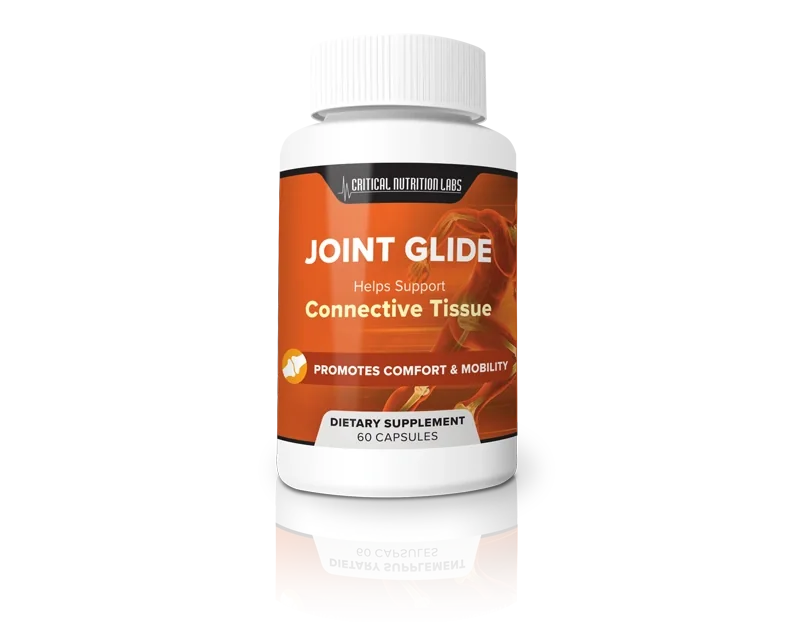
No result is promised here. If you want to test it yourself, checkout shows the price and the refund window.
See today's price and guaranteeEarnings disclosure: Thejointglide is the U.S. stocking partner for Joint Glide and earns a commission on orders placed through this site.Key facts
- Label claims: Helps Support Connective Tissue; Promotes Comfort & Mobility. No disease is named.
- Glucosamine is printed at 200 mg, near an eighth of the 1,500 mg daily figure most trials used.
- MSM 300 mg is about a fifth of the lowest dose in knee trials.
- Pine bark at 150 mg falls within the 100 to 200 mg that studies usually test.
- No study of this product, and no verified before-and-after, was supplied to us.
- Our editorial score for the product is 3.4 out of 5, with dose against research at 2.5.
Joint Glide is a dietary supplement. It is not FDA approved, and no supplement is. It is not meant to diagnose, treat, cure or prevent any disease. This page is general information, not medical advice. Ask your doctor or pharmacist about your own case.
Check 1: What does the label actually claim?
Two things. Helps Support Connective Tissue sits under the product name. Promotes Comfort & Mobility sits in an orange band.
Neither claim uses the words relieves, eliminates or restores. Neither names a disease. Words like comfort and mobility have no cut-off point, so a claim made with them is hard to prove wrong. That is true of most of the category.
So when you ask whether it works, ask what you are expecting. The label offers modest support language, not a cure. If the promise is small, then success is small and personal too, and you are the only fair judge of it.
Check 2: Do the printed doses match the studied doses?
This is where the answer gets mixed. Look at the two headline joint ingredients.
| Ingredient | Printed | Studied | Gap |
|---|---|---|---|
| Glucosamine hydrochloride | 200 mg | 1,500 mg a day in most trials | About 13% |
| MSM | 300 mg | 1.5 to 6 grams a day in knee trials | Roughly a fifth of the low end |
| Pine bark extract | 150 mg | 100 to 200 mg | Inside the range |
| Black pepper extract | 10 mg | 5 to 20 mg typical | Consistent with an absorption aid |
| Devil's claw root powder | 500 mg | No marker dose stated | No like-for-like comparison |
| White willow bark extract | 150 mg | No salicin figure stated | Exposure cannot be estimated |
Check 3: What does the glucosamine evidence say?
In 2018 the NCCIH reported on an analysis of 29 studies. Taken one at a time, glucosamine or chondroitin cut overall pain by a meaningful margin. Taken as a pair, they did not. The big guideline bodies also disagree about whether to use them.
The NCCIH also notes that prescription glucosamine sulfate performed more favourably than other forms. Joint Glide uses the hydrochloride. And the amount is 200 mg.
Put those facts together and you get a careful answer. The evidence is mixed in general, and this product is a lower dose of a different form.
Check 4: Is any ingredient well matched to research?
Yes, one. Pine bark extract at 150 mg, standardised to 95% proanthocyanidins, sits inside the range such extracts are usually studied at. It is the best-matched line on the label.
Black pepper extract at 10 mg is there as a helper for absorption, not as a star.
Devil's claw and white willow bark are the two where the label stops short. Without a harpagoside percentage or a salicin percentage, we cannot say whether the amounts match anything in the literature.
Check 5: Is there a study of this product?
None was supplied to us. The marketing pack included two images of real papers, one on enzymes in cartilage biology and one on lead in ground turmeric. Both papers are real. Neither tested Joint Glide, and the capsule holds no turmeric.
So do not let a picture of a paper stand in for evidence about the capsule. Ask what the paper tested, in whom, at what dose.
Check 6: Are there before-and-after stories or verified reviews?
No verified ones. The review block we received carried its own note: the score, the counts and the names were there for page layout. We therefore print none of it and leave out the photographs.
That means we cannot tell you how many buyers were pleased or how long they waited. If you see a before-and-after photo for Joint Glide online, treat it as unverified. A photograph cannot show a dose, a diet or a change in medication.
Check 7: What is a fair way to test it for yourself?
Talk to your doctor first, especially if you take a blood thinner or have a shellfish allergy. Then set a plan.
- Write down today's baseline in your own words: what you do and what bothers you.
- Take the capsules exactly as labelled, for a stretch you and your doctor agree on.
- Keep a short weekly note. Do not change anything else at the same time if you can avoid it.
- Compare the notes at the end. Decide with your doctor whether to continue.
- If you are not happy, use the 60-day window.
No timeline has been published for this product, so we cannot tell you how long a fair test takes.
Frequently asked questions
Does Joint Glide really work?
No result is promised. The front of the label makes two modest support claims and nothing stronger. No study of this exact product was supplied to us, so we cannot say it works for you.
How does Joint Glide work?
The label does not explain a mechanism. It lists ten ingredients with amounts. Some, like pine bark, sit inside studied ranges. Others, like glucosamine and MSM, are printed below the doses used in trials.
Is Joint Glide for arthritis?
No disease is named on the pack, and this site does not describe the product as treating arthritis. Ask your doctor about any joint condition.
Is there science behind Joint Glide?
Its ingredients have been studied one by one, with mixed results. The NCCIH reported in 2018 on glucosamine and chondroitin: each alone helped overall pain, the pair did not. No study of this formula was supplied.
Are there Joint Glide before and after results?
No verified ones were supplied. The comments we were given were placeholders for page layout, so none are shown.
What does the label mean by comfort and mobility?
It is a modest claim with no measuring line. It does not say relieves or restores, and it names no disease.
Our view
Our honest answer is: it might suit some people, and we cannot promise it will suit you. The label is modest, the numbers are printed, and the evidence for the main ingredients is mixed.
What we can say is where the weak points are. The glucosamine and MSM amounts are low against trial doses. The botanicals lack marker percentages. No study of the formula was supplied.
If you still want to try it, do it with your doctor in the loop, keep notes and treat the 60-day window as your safety net.
Planning a careful trial with your doctor? Look at the price and the 60-day guarantee first.
See today's price and guaranteeEarnings disclosure: Thejointglide is the U.S. stocking partner for Joint Glide and earns a commission on orders placed through this site.Last updated October 16, 2026. Written by Thejointglide Editorial Desk. Medically reviewed by Dr. Matthew Sloan, MD on October 16, 2026.
Keep reading: