
Joint Glide and Cartilage Support: 5 Checks on What the Label Says
Searchers pair Joint Glide with cartilage. The label is more careful than the search box.
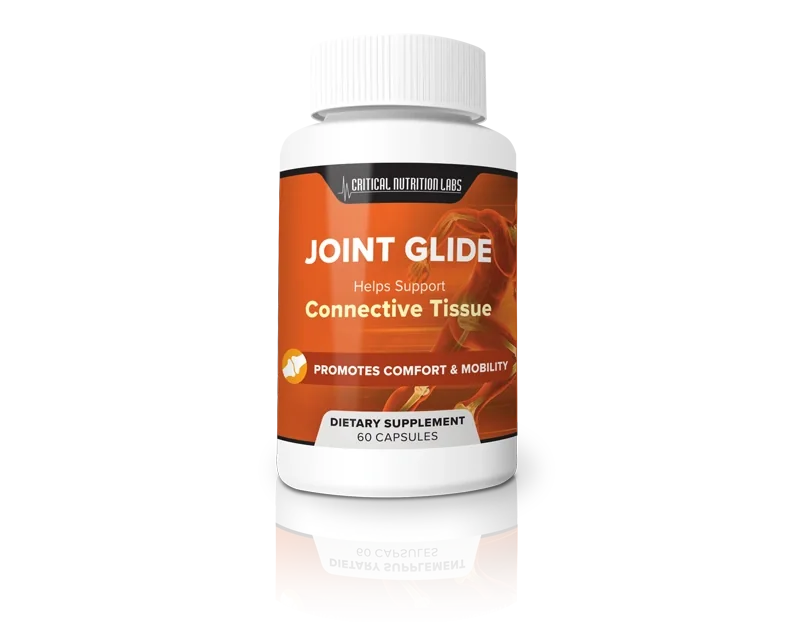
The Joint Glide label says Helps Support Connective Tissue. It does not say cartilage, and no animal cartilage appears on the panel. Glucosamine is a substance found in cartilage, but no study of this capsule on cartilage was published to us. Five checks below show how to read the word.
- Key facts
- Check 1: Does the label actually mention cartilage?
- Check 2: Is there cartilage inside the capsule?
- Check 3: Why does glucosamine keep coming up with cartilage?
- Check 4: What are the enzyme and rust pictures about?
- Check 5: Do cartilage supplements work, and what should you do?
- What would count as proof about cartilage?
- What do the words on the pack and in the search box look like side by side?
- Frequently asked questions
- Our view
Prefer to read the real panel? Checkout shows the price and the 60-day guarantee.
See today's price and guaranteeEarnings disclosure: Thejointglide is the U.S. stocking partner for Joint Glide and earns a commission on orders placed through this site.Key facts
- The label wording is connective tissue, not cartilage.
- No cartilage-derived ingredient appears on the panel.
- Glucosamine is an amino sugar found in cartilage. That describes the substance, not a result.
- The marketing pack shows an enzyme picture and a cartilage review from 2016. Neither studied this product.
- No study of this capsule on cartilage was published to us.
- Pain that is fresh, sharp or growing needs a doctor's eye.
Joint Glide is a dietary supplement. It is not FDA approved, and no supplement is. It is not meant to diagnose, treat, cure or prevent any disease. This page is general information, not medical advice. Ask your doctor or pharmacist about your own case.
Check 1: Does the label actually mention cartilage?
No. The front says Helps Support Connective Tissue and Promotes Comfort & Mobility. The word cartilage is not on it.
The gap between the label and the search box is worth noting. People type joint glide cartilage and joint pain and cartilage support. Those are search habits. Connective tissue is a wider term, and it is the one the maker chose.
So if a page tells you the bottle promises cartilage repair, it has gone past the label. Close that tab.
Check 2: Is there cartilage inside the capsule?
Look at the panel. Ten ingredients: four nutrients, devil's claw, MSM, glucosamine hydrochloride, pine bark, white willow bark and black pepper extract. None is a cartilage product.
This matters because some supplements are made from animal cartilage, such as bovine, chicken or shark cartilage. People search for those by name. Joint Glide is not one of them. We have no information on cartilage products, so we do not compare.
The other-ingredients line is short too: cellulose and olive oil.
Check 3: Why does glucosamine keep coming up with cartilage?
Our how-it-works page describes glucosamine as an amino sugar found in cartilage. That is a statement about the substance. It is a building block seen in the tissue.
A building block in the tissue does not prove that swallowing it changes the tissue. Studies are the only way to test that, and those studies are mixed. The NCCIH summary of 29 knee studies from 2018 saw less pain with each substance alone, and no such drop with the pair.
The capsule also prints glucosamine at 200 mg, against about 1,500 mg in most trials. So the link between the word and this capsule is thin on two counts.
Check 4: What are the enzyme and rust pictures about?
The marketing pack shows a rusted hinge, an enzyme drawn without a label, and a screenshot of a 2016 review in Disease Markers on enzymes called matrix metalloproteases in cartilage biology. We looked the paper up. It is real. It is not a study of this product.
Think of the pictures as mood. A rusty hinge is a metaphor for a stiff joint. It is not a measurement. The pack contains no result showing that Joint Glide changes any enzyme.
The pack also holds a green-tea compound banner, though there is no green tea on the panel, and a turmeric photo, though there is no turmeric. These mismatches are the reason we trust the panel over the pictures.
Check 5: Do cartilage supplements work, and what should you do?
Our sources do not rank cartilage supplements or name a best one. The best cartilage supplement, the best supplement for knee pain and the best joint supplement for 2026 are searches we cannot answer with facts we hold. A page that crowns a winner is selling something.
What we can say is narrow. For the one product here, the claim is support wording, the glucosamine is far below trial doses, and the research on glucosamine is mixed.
If your knee hurts, the useful step is not a bottle. See a doctor. A doctor can look at the joint, ask about medicines and say whether a supplement is sensible. Bring the panel. It prints every amount.
A few plain questions for that visit: what do you think is going on in this joint, what can I do with movement or weight, do any of my medicines clash with willow bark, and is a supplement worth a short trial? Write the answers down.
What would count as proof about cartilage?
It helps to know what real evidence would look like, so you can spot its absence. A claim about cartilage would need a study in people who took this exact capsule, a measurement of the tissue or of function taken before and after, and a comparison group that took something else.
None of that was published to us. No before and after scan, no function test and no comparison group came with the pack. The 2016 enzyme paper is science about cartilage in general, which is a different thing from science about this bottle.
Until such a study exists, keep the word cartilage in the category of background, not promise.
What do the words on the pack and in the search box look like side by side?
| On the pack | In the search box | Our reading |
|---|---|---|
| Helps Support Connective Tissue | Joint pain and cartilage support | Wider on the pack than in searches |
| Promotes Comfort & Mobility | Joint glide mobility | No measuring line, no result promised |
| Glucosamine hydrochloride, 200 mg | Joint glide glucosamine | Far below trial dose |
| No cartilage ingredient | Cartilage supplements | Joint Glide is not one |
| No disease named | Knee cartilage supplement | No knee claim on the label |
Frequently asked questions
Does Joint Glide support cartilage?
The label says Helps Support Connective Tissue and does not use the word cartilage. No study of the capsule on cartilage was published to us.
Is there cartilage in Joint Glide?
No. None of the ten ingredients on the panel is an animal cartilage product.
Does glucosamine rebuild cartilage?
Glucosamine is an amino sugar found in cartilage, but that does not show it rebuilds anything. NCCIH reports mixed findings on it, and this capsule prints a low dose.
What is the enzyme picture on the Joint Glide pack?
It is marketing art, along with a real 2016 review on cartilage enzymes. The review is not a study of this product.
Do cartilage supplements work?
Our sources do not cover cartilage-derived supplements, so we make no claim. For glucosamine, NCCIH reports a mixed picture.
Should I take Joint Glide for knee pain?
Ask a doctor first. The label makes no knee claim, and pain that is new, severe or getting worse needs an exam.
Our view
Cartilage is a search word, not a label word. Joint Glide stays at connective tissue and comfort, and it deserves credit for that restraint.
The pictures on the pack say more than the panel does. Treat them as decoration. The numbers, not the rusty hinge, are the evidence.
If cartilage worries you, spend your first effort on a doctor visit. Then, if the capsule still looks right, use the guarantee date to keep the trial honest.
Wording understood and expectations set? See today's price and guarantee at checkout.
See today's price and guaranteeEarnings disclosure: Thejointglide is the U.S. stocking partner for Joint Glide and earns a commission on orders placed through this site.Last updated October 16, 2026. Written by Thejointglide Editorial Desk. Medically reviewed by Dr. Matthew Sloan, MD on October 16, 2026.
Keep reading: